

What Rising Treasury Yields and Fed Policy Mean for CRE Borrowers
Commercial real estate borrowers hoping for lower interest rates this fall have received some disappointing news. Over the past several weeks, interest rates have moved higher again. The Federal Reserve raised its benchmark rate by 0.25% on September 16, while Treasury yields have also climbed sharply.
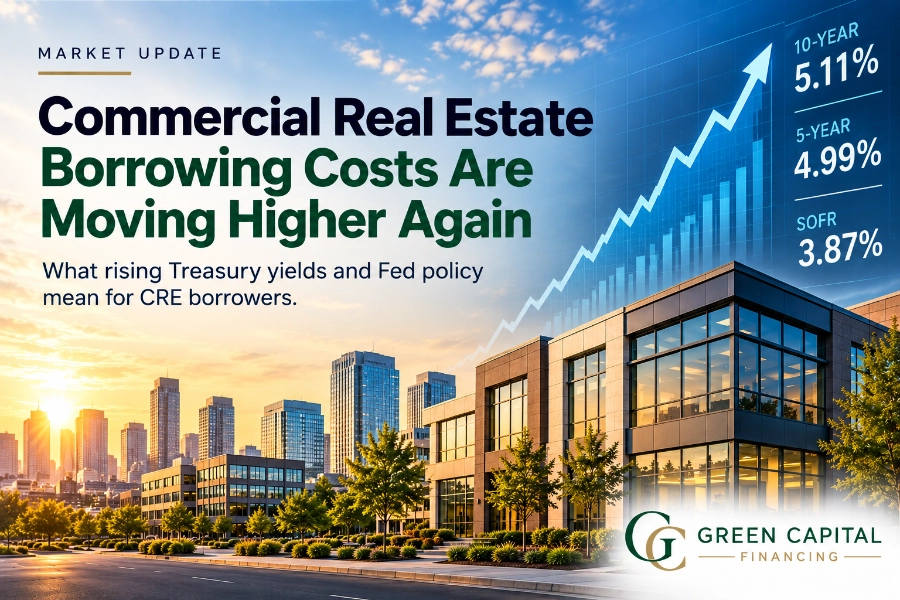
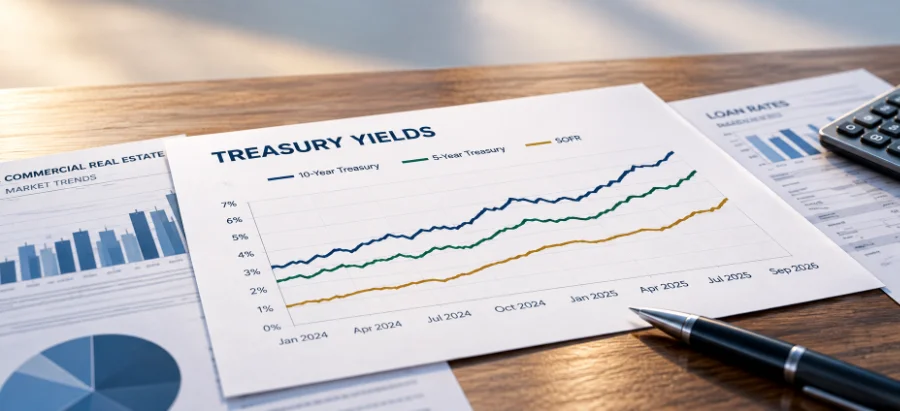
As of September 24, the 5-year Treasury had risen to approximately 4.99%, while the 10-year Treasury reached approximately 5.11%.
For commercial real estate investors and business owners, those numbers matter because they can directly affect the rates available when purchasing or refinancing commercial property.
What’s Happening in the Bond Market?
One of the biggest changes since the beginning of September has been the sharp increase in longer-term Treasury yields.
The 10-year Treasury has moved above 5%, while longer-term government bond yields have reached levels not seen in decades. There isn’t one single reason for the increase.
Investors remain concerned about inflation, higher energy prices, continued economic growth and the amount of debt being issued by the federal government. Similar pressure has also been showing up in bond markets around the world.
When investors demand higher yields to hold government bonds, those higher rates tend to work their way into other types of borrowing—including commercial real estate loans.
The Fed Raised Rates Too
The bond market isn’t the only source of higher borrowing costs.
On September 16, the Federal Reserve increased its benchmark interest rate by 0.25%, bringing its target range to 3.75%–4.00%.
That move has a particularly direct impact on floating-rate commercial real estate loans. Many bridge, construction and transitional commercial real estate loans are priced using SOFR, a short-term interest rate that generally moves closely with Federal Reserve policy.
When the Fed raises rates, borrowers with these types of loans can see their interest expense increase relatively quickly.
Why Treasury Rates Matter for CRE Investors
The Federal Reserve gets most of the headlines, but commercial real estate investors should also pay close attention to Treasury rates.
Many fixed-rate commercial real estate loans are priced using Treasury yields as a starting point. For example, a lender might price a loan based on the 5-year Treasury rate plus an additional spread.
If the Treasury rate increases 0.25%, the borrower’s final interest rate may also increase by roughly that amount unless the lender reduces its spread.
That can make a noticeable difference in both monthly payments and how much a property can support in loan proceeds.
What Does This Mean if You’re Buying a Property?
Higher rates don’t necessarily mean investors should stop buying commercial real estate. They do mean the numbers need to work at today’s financing costs.
If you’re considering an acquisition, it’s worth running the property using the interest rate you can realistically obtain today rather than assuming you’ll be able to refinance at a substantially lower rate next year.
The good news is that lenders are still actively looking for quality transactions. Banks, credit unions, agency lenders, life insurance companies and private lenders continue to compete for commercial real estate loans.
So the current challenge isn’t necessarily finding financing. It’s finding the right financing at a cost that still allows the investment to make sense.
What About Refinancing?
Property owners approaching a loan maturity may face a bigger challenge.
Many commercial properties were financed several years ago when interest rates were substantially lower. Refinancing those loans today can result in higher monthly payments and, in some cases, lower loan proceeds.
That makes it especially important to start reviewing refinancing options well before the existing loan matures.
Different lenders can have significantly different requirements for loan-to-value, debt-service coverage, amortization and interest rates.
Shopping the loan early gives borrowers more time to compare those options.
Should Borrowers Wait for Rates to Come Down?
Rates could certainly decline if inflation cools or economic growth slows. But the recent bond-market activity is a reminder that rates can also move in the opposite direction.
The 10-year Treasury moving back above 5% demonstrates why trying to perfectly time the interest-rate market can be difficult.
Instead of asking whether rates will definitely be lower six months from now, investors may be better served asking a different question:
Does this transaction make sense with the financing available today?
If the answer is yes, borrowers can also look for loan structures that provide flexibility to refinance later if rates eventually decline.
The Bottom Line
The commercial real estate financing market has changed noticeably during September. The Federal Reserve has raised short-term rates, Treasury yields have moved higher, and the bond market remains volatile.
For investors and business owners, that means borrowing costs could remain elevated for a while longer. But capital is still available.
The key is comparing lenders, understanding how each loan is being priced and making sure the financing structure fits both the property and your longer-term plans.
At Green Capital Financing, we help commercial real estate investors, property owners and business owners compare financing options from multiple lending sources.
If you’re purchasing or refinancing a commercial property, we can help you evaluate the available financing and determine which loan structure makes the most sense for your transaction.

Mike Reible is a commercial mortgage broker, intermediary, and licensed real estate broker with 25 years of experience. As a seasoned expert, Mike and his team serve investors, developers, and business owners nationwide.
Mr. Reible specializes in structuring financing for multifamily, mixed-use, and income-producing properties. Through GreenFinancing.com, Mike shares insights, market trends, and financing strategies tailored to today’s evolving commercial real estate landscape.
949-614-1300 Office
Mike@GreenFinancing.com