

Commercial Real Estate Interest Rate Outlook for Fall 2026: What Borrowers Should Expect
After several years of rapidly changing interest rates, commercial real estate investors are entering the fall of 2026 with a familiar question:
Where are commercial real estate interest rates headed next?
The answer is more complicated than simply predicting what the Federal Reserve will do.
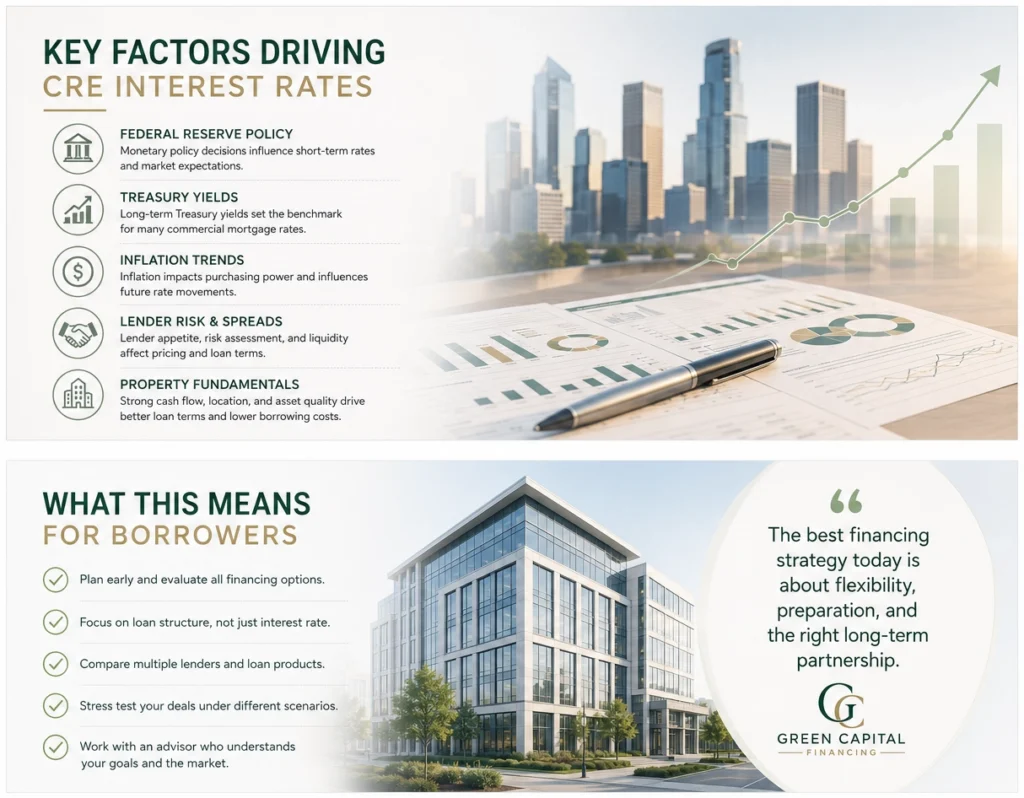
Commercial mortgage rates are influenced by a combination of Federal Reserve policy, Treasury yields, inflation expectations, lender spreads, property fundamentals and the perceived risk of an individual transaction.
And right now, those forces aren’t necessarily moving in the same direction.
For commercial real estate borrowers, that makes understanding the capital markets increasingly important when deciding whether to acquire, refinance or reposition a property.
Where Interest Rates Stand Entering Fall 2026
Long-term Treasury yields have recently moved higher. On September 2, the 10-year Treasury yield stood at approximately 4.66%, compared with 4.49% on August 31.
That’s particularly important for commercial real estate because many permanent commercial mortgages are priced using a Treasury benchmark plus a lender spread.
In other words, a borrower can see commercial mortgage rates increase even if the Federal Reserve doesn’t raise short-term rates.
The Federal Reserve maintained its target rate at its July meeting, while its next scheduled FOMC meeting is September 15–16.
That leaves borrowers facing an environment where both monetary policy and the bond market need to be watched carefully.
Why Treasury Yields Matter to Commercial Real Estate
One of the biggest misconceptions among CRE investors is that commercial mortgage rates move directly with the federal funds rate.
They don’t.
Many longer-term commercial mortgages are more closely connected to Treasury yields, particularly the 5-, 7- and 10-year Treasury.
A simplified commercial mortgage rate might look something like:
Treasury Yield + Lender Spread = Borrower’s Interest Rate
For example, if the relevant Treasury benchmark rises 25 basis points while the lender’s spread remains unchanged, the borrower’s rate could increase by approximately the same amount.
That seemingly small change can materially affect loan proceeds.
Higher rates increase debt service, which can reduce debt-service coverage ratios (DSCR) and potentially lower the amount a lender is willing to advance.
The Good News: Credit Conditions Are Improving
Interest rates aren’t the only factor determining whether a commercial real estate loan gets done.
Credit availability matters just as much.
There are signs that lending conditions have improved.
Federal Reserve reporting from its July Senior Loan Officer Opinion Survey indicated that bank lending standards had eased on net for the fourth consecutive quarter while demand for credit had strengthened for the fifth consecutive quarter.
That’s significant.
During the most restrictive portion of the recent CRE lending cycle, borrowers faced two problems simultaneously:
Higher interest rates and tighter underwriting.
An environment where lenders are becoming more willing to compete for quality transactions can partially offset the impact of stubbornly high benchmark rates.
What Could Push Commercial Mortgage Rates Lower?
Several developments could create a more favorable borrowing environment later in 2026 and into 2027.
The most important would be sustained progress on inflation.
If inflationary pressures moderate, the Federal Reserve would have greater flexibility regarding monetary policy. Lower inflation expectations could also place downward pressure on longer-term Treasury yields.
But borrowers shouldn’t assume that falling Fed rates automatically mean dramatically lower commercial mortgage rates.
The bond market may have other ideas.
Treasury yields incorporate expectations about economic growth, inflation, government borrowing and investor demand. Recent increases in longer-term yields illustrate why commercial mortgage borrowers need to watch more than the Federal Reserve.
What Could Keep CRE Rates Higher?
There are also legitimate reasons commercial borrowing costs could remain elevated.
Inflation remains a concern, and recent Federal Reserve reporting has continued to describe price pressures across parts of the economy. The September Beige Book reported modest economic growth alongside continued increases in prices, although conditions varied across Federal Reserve districts.
A resilient economy can also keep longer-term yields elevated.
That creates an interesting dynamic for CRE investors: economic strength is generally positive for property fundamentals, but it can simultaneously keep borrowing costs higher.
The Refinancing Challenge Isn’t Over
One of the largest opportunities—and risks—in commercial real estate continues to be the refinancing market.
Properties financed several years ago may now face refinancing at substantially higher interest rates.
Consider a property that previously carried a 4% mortgage but now needs to refinance at 6% or 7%.
Even if the property’s net operating income hasn’t declined, the increased debt service can dramatically change the transaction.
Borrowers may encounter:
- Lower loan proceeds
- Higher DSCR requirements
- Additional equity requirements
- Cash-in refinancing
- Shorter amortization periods
- Interest reserves
- More stringent underwriting
This doesn’t necessarily mean the property cannot be refinanced.
It means the capital structure may need to change.
Why Shopping the Lending Market Matters More Today
When rates were extremely low and credit was plentiful, differences between lenders could sometimes be relatively small.
That’s no longer the case.
Today we routinely see meaningful differences in leverage, pricing, amortization, recourse requirements, prepayment structures and underwriting among lenders evaluating the same transaction.
A commercial bank may view a property differently from a credit union.
A debt fund may structure a transitional property differently from a conventional lender.
And multifamily borrowers may have access to agency financing that isn’t available for other commercial property types.
That makes lender selection increasingly important.
The lowest advertised rate isn’t necessarily the best financing.
The objective should be finding the capital structure that best fits the property and the borrower’s investment strategy.
Should Borrowers Wait for Rates to Fall?
This is one of the most common questions we’re hearing from investors.
And the answer depends on the transaction.
Waiting may make sense when a borrower has flexibility and the economics of a transaction don’t work at today’s rates.
But waiting solely because rates might decline creates another risk.
If borrowing costs fall, transaction activity may increase. Increased investor demand can place upward pressure on property values and reduce acquisition opportunities.
An investor who saves 50 basis points on financing but pays substantially more for the property hasn’t necessarily improved the investment.
Instead of trying to perfectly time interest rates, investors should evaluate whether the transaction makes sense under today’s financing assumptions.
If it does, future refinancing may provide additional upside.
Five Strategies CRE Borrowers Should Consider Now
In the current market, we recommend that borrowers focus on five areas.
1. Start refinancing discussions early.
Don’t wait until 30 or 60 days before maturity. More complicated transactions may require considerably more time.
2. Compare multiple lending sources.
Banks, credit unions, agency lenders, CMBS lenders, bridge lenders and private credit funds can evaluate the same transaction very differently.
3. Evaluate loan structure—not just interest rate.
Amortization, prepayment penalties, recourse, reserves and loan proceeds can be just as important as the note rate.
4. Stress-test the property.
Analyze the investment under multiple rate and NOI scenarios before committing to financing.
5. Keep refinancing flexibility in mind.
If you believe rates could decline over the next several years, carefully evaluate prepayment penalties and yield-maintenance provisions before locking into long-term debt.
Our Commercial Real Estate Rate Outlook
We expect the commercial real estate financing environment to remain selective but increasingly competitive for strong transactions.
The key distinction is that improving credit availability doesn’t necessarily mean a return to ultra-low interest rates.
Borrowers should instead prepare for a market where capital becomes more available while lenders continue to emphasize debt-service coverage, borrower strength, liquidity and property-level fundamentals.
For investors, that isn’t necessarily bad news.
Periods of uncertainty frequently create opportunities for well-capitalized borrowers who understand both the real estate and financing sides of a transaction.
The borrowers best positioned for the next phase of the CRE cycle will likely be those who prepare early, maintain financing flexibility and evaluate multiple sources of capital rather than attempting to perfectly time interest rates.
Need Commercial Real Estate Financing?
Green Capital Financing helps commercial real estate investors and property owners evaluate financing options across a wide range of property types and transaction structures.
Whether you’re acquiring a property, refinancing existing debt or evaluating financing for a transitional asset, we can help identify lending options and structure financing around your investment objectives.
Connect with Green Capital Financing to discuss your next commercial real estate financing opportunity.

Mike Reible is a commercial mortgage broker, intermediary, and licensed real estate broker with 25 years of experience. As a seasoned expert, Mike and his team serve investors, developers, and business owners nationwide.
Mr. Reible specializes in structuring financing for multifamily, mixed-use, and income-producing properties. Through GreenFinancing.com, Mike shares insights, market trends, and financing strategies tailored to today’s evolving commercial real estate landscape.
949-614-1300 Office
Mike@GreenFinancing.com