

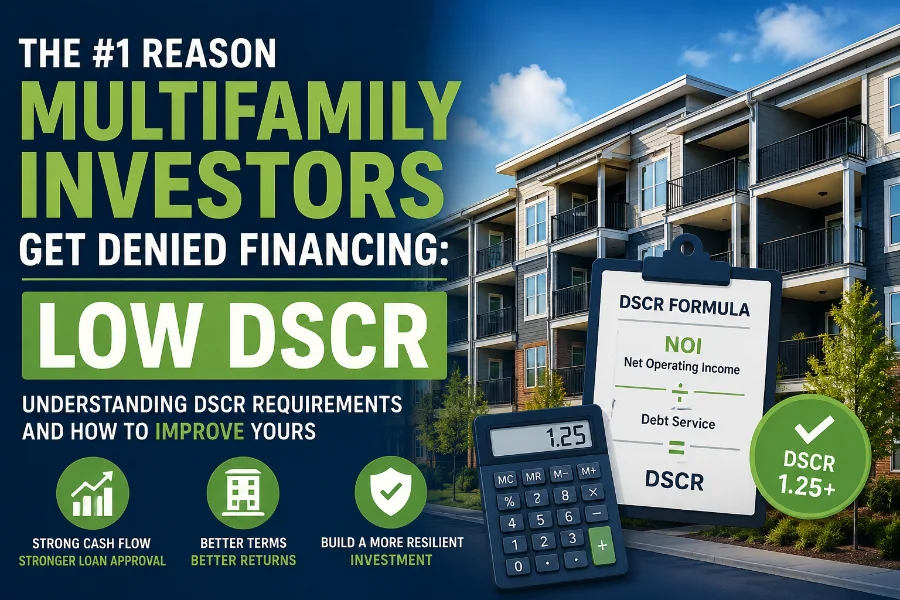
Many multifamily investors are surprised when a lender declines their loan application. The property may be in a desirable location, the borrower may have good credit, and there may even be significant equity in the transaction. Yet the loan is denied.
One of the most common reasons for an apartment loan denial is a low Debt Service Coverage Ratio, commonly known as DSCR.
Understanding how lenders evaluate DSCR can help investors improve their chances of approval and secure better financing terms. Whether you’re purchasing your first multifamily property or expanding an existing portfolio, knowing how DSCR works is essential.
What Is DSCR?
Debt Service Coverage Ratio (DSCR) is a financial metric lenders use to determine whether a property generates enough income to cover its mortgage payments.
The formula is straightforward:
DSCR = Net Operating Income (NOI) ÷ Annual Debt Service
Net Operating Income represents the property’s income after operating expenses but before mortgage payments, depreciation, and income taxes.
For example:
- Annual Net Operating Income: $150,000
- Annual Mortgage Payments: $120,000
DSCR = 1.25
This means the property generates 25% more income than is required to make its annual debt payments.
The higher the DSCR, the more comfortable lenders are that the property can withstand unexpected vacancies, repairs, or market fluctuations.
Why Lenders Focus So Heavily on DSCR
Unlike residential mortgages, commercial and multifamily lenders place significant emphasis on the property’s ability to support the loan.
A lender wants to know:
- Will rental income cover the mortgage payment?
- Can the property survive temporary vacancies?
- Is there enough cash flow to absorb rising expenses?
- How likely is the borrower to experience financial stress during ownership?
A strong DSCR provides confidence that the property can continue performing even if conditions become less favorable.
For this reason, DSCR is often one of the first metrics reviewed during underwriting.
Typical Multifamily DSCR Requirements
Most multifamily lenders require a minimum DSCR between 1.20 and 1.30.
While requirements vary by lender and loan program, common guidelines include:
Bank Financing
- Typical minimum DSCR: 1.25x
- Often requires strong borrower financials and experience
Agency Financing
- Typical minimum DSCR: 1.25x
- May vary depending on property size and market
Credit Unions
- Typical minimum DSCR: 1.20x to 1.30x
Bridge Loans
- May allow lower DSCR depending on the business plan
- Focus often placed on future stabilization potential
SBA Owner-Occupied Loans
- Generally require adequate cash flow coverage from the business occupying the property
If a property falls below a lender’s minimum requirement, approval becomes significantly more difficult.
Common Reasons Multifamily Properties Have Low DSCR
Many investors assume a property is profitable because it produces positive cash flow. However, lenders may view the situation differently.
Here are several common factors that can reduce DSCR:
High Vacancy Rates
Vacancies directly reduce rental income and lower Net Operating Income.
A property with multiple vacant units may struggle to meet minimum coverage requirements, even if market rents are strong.
Excessive Operating Expenses
Rising insurance costs, property taxes, maintenance expenses, and utility costs can significantly impact NOI.
Many investors underestimate how closely lenders analyze operating expenses.
Over-Leveraged Transactions
Borrowers sometimes seek larger loan amounts than the property’s income can support.
Even strong properties can fail DSCR requirements when leverage is too aggressive.
Below-Market Management
Poor property management can lead to lower occupancy, higher turnover, and missed opportunities to increase revenue.
Lenders often review management performance when evaluating multifamily properties.
Unrealistic Rent Projections
Underwriters typically rely on current income and documented operating history rather than projected future performance.
If the property’s current rents do not support the requested loan amount, DSCR may fall below required thresholds.
How to Improve DSCR Before Applying for Financing
The good news is that many DSCR issues can be addressed before submitting a loan application.
Increase Rental Income
One of the most effective ways to improve DSCR is to increase Net Operating Income.
Strategies may include:
- Raising below-market rents where appropriate
- Reducing vacancies
- Improving tenant retention
- Adding income-producing amenities
- Implementing utility reimbursements
Even modest increases in NOI can have a meaningful impact on DSCR.
Reduce Operating Expenses
Investors should carefully review operating costs and identify opportunities for savings.
Potential improvements include:
- Renegotiating vendor contracts
- Improving energy efficiency
- Reviewing insurance coverage
- Reducing unnecessary maintenance expenses
Every dollar saved increases NOI and strengthens DSCR.
Consider a Larger Down Payment
A larger equity contribution reduces the loan amount and lowers annual debt service.
This often improves DSCR and may help secure more favorable loan terms.
Refinance Existing Debt
If interest rates or loan terms are creating excessive debt service, refinancing may improve coverage ratios.
Longer amortization periods can sometimes reduce annual debt obligations and strengthen cash flow metrics.
Stabilize the Property Before Applying
Lenders generally prefer stabilized multifamily assets.
Improving occupancy, collecting consistent rents, and demonstrating several months of stable operations can significantly improve underwriting results.
Don’t Let a Low DSCR End Your Investment Plans
A low DSCR does not always mean financing is impossible.
Many investors assume a lender’s decline is the end of the road, when in reality it may simply mean a different loan program or lending source is needed.
Banks, agency lenders, bridge lenders, private lenders, and credit unions often evaluate transactions differently. An experienced commercial mortgage advisor can help identify financing options that align with the property’s current performance and long-term business plan.
At Green Capital Financing, we work with multifamily investors nationwide to navigate underwriting challenges and explore financing solutions for apartment buildings, investment properties, and commercial real estate acquisitions.
Final Thoughts
When it comes to multifamily financing, few metrics are more important than Debt Service Coverage Ratio.
A low DSCR remains one of the leading reasons investors receive apartment loan denials. Fortunately, understanding how lenders evaluate cash flow and preparing your property accordingly can dramatically improve your chances of approval.
Before applying for financing, take the time to review your property’s income, expenses, occupancy, and projected debt service. A stronger DSCR not only increases approval odds but can also help you secure better rates, terms, and long-term investment success.
If you’re planning to acquire, refinance, or reposition a multifamily property, Green Capital Financing can help you evaluate your financing options and determine whether your property meets current lender requirements.

Mike Reible is a commercial mortgage broker, intermediary, and licensed real estate broker with 25 years of experience. As a seasoned expert, Mike and his team serve investors, developers, and business owners nationwide.
Mr. Reible specializes in structuring financing for multifamily, mixed-use, and income-producing properties. Through GreenFinancing.com, Mike shares insights, market trends, and financing strategies tailored to today’s evolving commercial real estate landscape.
949-614-1300 Office
Mike@GreenFinancing.com